How Long Does It Really Take to Build a Custom Home in Walker County?
Somewhere in the first conversation, usually right after the question about cost, comes the one everybody asks: how long is this going to take? It is a fair question and it deserves a straight answer. You may be renting month to month, living with family, or trying to time a move around a school year or a new job. A vague "it depends" does not help you plan your life.
The honest answer is still a range, but it can be a specific one. At Bales Home Solutions, we build in Walker and Catoosa County every week, and we know where the time goes around here: which steps move fast, which ones drag, and which ones are inside your control. What follows is a stage-by-stage look at the real timeline from the first meeting to the day you get keys, with plain numbers and the reasons behind them.
The Short Answer, and Why It Is a Range
For a typical custom home in Walker County, most families should plan on somewhere around a year from a signed building agreement to move-in, with a few more months in front of that for design, lot evaluation, financing, and permits. Smaller, simpler homes on easy lots can come in under that. Larger homes, difficult sites, or heavy custom finish work can run past it.
Nobody can promise a date on day one, and you should be cautious of anyone who does. What a builder can do is explain what moves the number. Four things set the pace more than anything else:
- How quickly plans are finalized and selections are made
- What the lot looks like underneath: soil, rock, slope, and drainage
- When the build starts relative to the wet season
- Lead times on materials and the availability of skilled trades
Keep those four in mind as you read the stages below. Nearly every delay in this area traces back to one of them. If you want a timeline built around your own lot and plan, tell us what you want and when you want to be in and we will give you a real estimate.
Before the First Shovel: Plans, Lot, Financing, and Permits
This stage gets overlooked because nothing visible is happening on the ground, but in Walker and Catoosa County it is often the longest single stretch of the project. Expect a few months, and longer if the lot has surprises.
Plans come first. If you are starting from a stock plan with modifications, drawings can be ready in a few weeks. A fully custom design from scratch takes longer, often a couple of months of back and forth. The time spent here is worth it. Changing a plan on paper costs almost nothing, while changing it after framing costs real money and real weeks.
Lot evaluation runs alongside the plans. If the home will be on septic, and most lots outside city limits are, the health department requires a soil evaluation before a septic permit is issued, and that permit is good for about a year. We also look at access, where the driveway will go, how the lot drains, and whether rock is likely. In this part of North Georgia that last question matters more than people expect.
Financing is on your side of the table but it affects the schedule. Construction loans need an appraisal based on the plans and budget, so the loan cannot close until the drawings are far enough along. Starting the lender conversation early saves weeks at the end.
Then permits. In Walker County, building permits go through the county planning office in Rock Spring. In Catoosa County, Code Enforcement handles permits for Ringgold, Fort Oglethorpe, and the unincorporated county, and the City of Fort Oglethorpe runs its own review on top of that. Turnaround is usually a couple of weeks when the paperwork is complete, but an incomplete submittal goes to the back of the line. Because Bales Home Solutions is based in LaFayette, not serving it from an hour away, walking a question into the Rock Spring office is a short drive rather than a scheduled trip. If you want to know what a lot will need before you buy it, call (423) 991-9252 and we will tell you what to look for.
For a fuller walkthrough of each phase, see our overview of the custom home building process from start to finish.
Site Work and Foundation: Weather and Soil Set the Pace
Once the permit is in hand, site work begins: clearing, grading, the driveway cut, and the footing. On a flat, dry lot with good soil this can be done in a couple of weeks. Around here that lot is the exception. Walker and Catoosa County have clay that holds water, rock that shows up where nobody expected it, and slopes that need retaining walls or stepped footings. Plan on several weeks for site work and foundation, and know that this is the stage most likely to surprise everyone, including us.
The calendar matters as much as the dirt. Late winter and spring are our wet season, and a footing cannot be poured into mud. Saturated red clay may need several dry days between rains before equipment can work on it, and a wet week can turn into a lost month. A build that breaks ground in late summer or fall often reaches dry-in before the heavy rains return, which is one reason we do not treat fall starts as a problem.
The footing inspection happens here, the first of the county's inspections. Nothing goes on top of the footing until it passes.
Framing to Dry-In
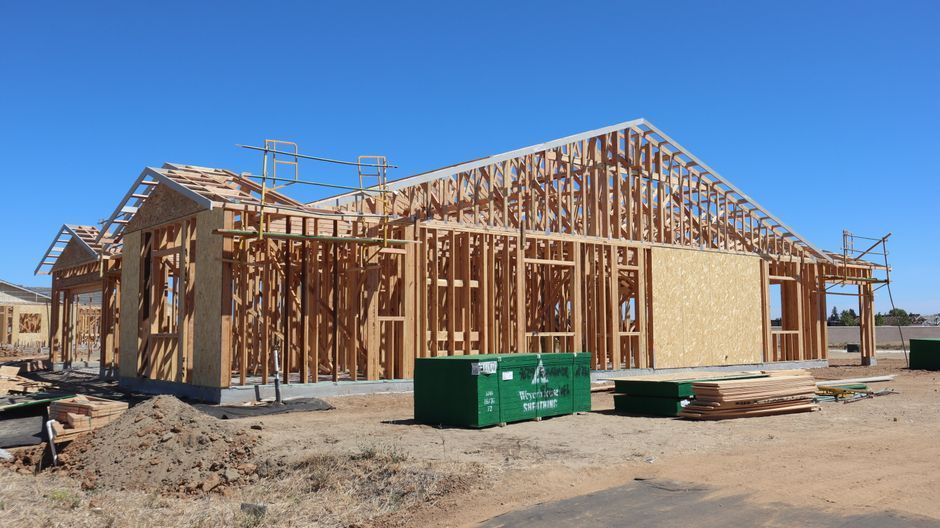
This is the stage owners enjoy most, because the house finally looks like a house. Framing, roof decking, roofing, windows, exterior doors, and house wrap together take roughly two to three months on a typical home. The goal is dry-in, the point where the weather stays outside and interior work can continue no matter what the sky is doing.
Two things can stretch this stage. The first is trusses and windows. Both are ordered weeks ahead, and if they arrive late, framing waits. We order as early as the plans allow, and we do not change window sizes after the order is placed. The second is crew availability. The pool of skilled framers in this area is smaller than in a big metro, and the good crews stay booked. We schedule them before the foundation is finished so the house does not sit waiting on a crew.
Mechanicals, Inspections, and the County Schedule
With the house dried in, the trades move inside: plumbing, electrical, and HVAC rough-in, followed by insulation. Expect a month or so. The trades have to work in order, and each one needs the one before it to finish, so one late plumber can hold up three other crews.
This is also where the county comes back. Walker County new construction typically involves four inspections: footing, rough-in, final electrical, and the final walk-through. The rough-in inspection has to pass before a single sheet of drywall goes up. Inspectors work on a schedule, not on demand, so we book the inspection as soon as a stage is close to ready and have the next trade lined up to start the day after a pass. A failed inspection is rarely a big problem, but the re-inspection is a lost week.
Scheduling around inspections is one of the quieter advantages of a local builder. We know the lead times, we know the process, and we are not driving in from somewhere else to meet an inspector at 8 a.m.
Finishes: The Stage Where Owners Control the Clock
Drywall, paint, cabinets, countertops, flooring, tile, trim, fixtures, and appliances are the longest stretch of the build on most homes, often three to four months. That is a wide range, and most of what moves it is selections.
Cabinets are the clearest example. Semi-custom cabinets can take a couple of months from order to delivery, and countertops cannot be templated until the cabinets are installed. If cabinet selections are not final by the time framing starts, the cabinets arrive late, the countertops follow, and the plumber cannot set the sinks. One late decision turns into a month.
Our advice is simple: make selections early, in one batch, and then leave them alone. A change order after drywall nearly always costs both money and time, even when the change itself seems small. If you want help building a selection schedule tied to your timeline, call (423) 991-9252 and we will walk through it with you.
The last few weeks are punch list, final cleaning, the final electrical inspection, the final walk-through, and the certificate of occupancy. From there, keys.
Five Things That Delay Builds in Walker and Catoosa County
- Late or changing selections. The single most common delay, and the most avoidable. Finalize cabinets, windows, exterior materials, and plumbing fixtures before framing starts.
- Wet-season site work. Foundations poured in February and March fight the rain. If you can, time the groundbreaking so the house is dried in before late winter, or build the wet weeks into the plan from the start.
- Rock and clay. Hitting rock during excavation adds days and cost. A good lot evaluation before you commit tells you what to expect.
- Material lead times. Windows, trusses, and cabinets are the usual culprits. Ordering early requires final plans, which loops back to the first item.
- Trade scheduling. The skilled trade pool here is small, and crews that get bumped move on to the next job. Builders who schedule trades weeks ahead keep the sequence moving.
Notice that two of the five are in your hands. The other three are things a local builder manages by planning ahead instead of reacting.
If you are building in Catoosa County, the permit path is a little different. Our guide to custom home building in Ringgold covers what to expect there.
Frequently Asked Questions
How long does it take to build a custom home in Walker County, GA?
Most custom homes take around a year from signed agreement to move-in, plus a few months of design, lot evaluation, financing, and permitting ahead of construction. Simple homes on easy lots can be faster. Difficult sites, large homes, and late selections push the number up. Ask us for a timeline estimate for your lot and plan.
What is the longest part of the process?
For many owners it is the pre-construction stage, because plans, the septic soil evaluation, financing, and permits all have to line up before anything happens on the lot. During construction, finishes are usually the longest stretch, and that is the stage you have the most influence over.
Can we start building in the fall or winter?
Yes, and in this area a late summer or fall start is often a good idea. The goal is to get the foundation in and the house dried in before the late winter and spring rains arrive. Starting site work in the middle of the wet season is what costs time, not cold weather.
How many inspections does the county do?
Walker County new construction typically involves four: footing, rough-in, final electrical, and a final walk-through. Catoosa County and the City of Fort Oglethorpe have their own schedules. Bales Home Solutions books each inspection as soon as a stage is ready so the next trade is not left waiting.
What causes the most delays?
Late selections and change orders cause more delays than weather, rock, or inspections. After that come material lead times on windows, trusses, and cabinets, and wet-season site work. Most of these can be planned around if the decisions are made early.
How can we speed things up on our end?
Finalize the plans before asking for a bid, start the lender conversation early, make all selections in one batch before framing, and respond quickly when a question comes up on site. If you want a selection schedule built around your dates, call (423) 991-9252 and we will set one up with you.
Get a Timeline Estimate for Your Lot and Plan
Every lot in Walker and Catoosa County has its own answer to the "how long" question, and the only way to get a real one is to look at the lot, the plan, and the calendar together. Bales Home Solutions offers a free timeline estimate for your lot and plan. Tell us what you want and when you want to be in, and we will tell you honestly whether that is realistic and what it would take to get there.
Or call Joseph Bales at (423) 991-9252. We are based in LaFayette, we build across Chickamauga, Rossville, Ringgold, Fort Oglethorpe, Rock Spring, Dalton, and the greater Chattanooga area, and we are glad to talk through a timeline before you have signed anything.